
Breakdown Blockbusters: How Quads Spacing Can Become Basketball’s Next Great Weakside Overload Offense
A full breakdown of the Quads alignment, weakside overload principles, DHO counters, hammer actions, and how one unconventional basketball spacing concept can grow into a complete offensive system

I. Introduction: Taking the blueprint off the wall
I’m doing something a little different here.
Most of the time in this space, I’m looking at someone else’s offense, someone else’s spacing, someone else’s solution to a defensive problem. That is the normal film-room exercise: find the good stuff, explain why it works, and maybe borrow a piece of it. It is like walking through somebody else’s house and pointing out the architecture.
This time, I’m opening the garage.
This is not me breaking down an NBA team’s pet set or a college coach’s favorite after-timeout play. This is something I have been building: a Quads alignment that puts four players on the weakside and one player alone on the strongside wing. It is an offensive structure, but it also feels like a thought experiment. How much can you bend the court before the defense loses its normal rules? How far can you overload one side before the other team stops defending basketball and starts just trying to survive traffic?
The fun of this alignment is that it looks wrong at first glance.
Basketball spacing has trained us to love balance. Corner filled, slot filled, wing filled, dunker occupied, everybody in a clean shell. The modern eye is used to five-out spacing, delay spacing, empty corner pick-and-roll, spread ball screens, and symmetrical slot-to-slot actions. Quads does something less polite. It takes four offensive players and parks them on the weakside, away from the ball, then leaves the ball handler or trigger man isolated on the strongside wing.
It is almost like throwing a party in one room of the house and leaving one person alone in the kitchen with the keys. The defense hears the noise on the weakside, sees all the bodies, sees all the screening possibilities, and still has to respect the lone player with the ball. The whole thing creates a strange tension: the ball is on one side, but the danger is everywhere else.
That is why I think Quads is more than a gimmick. It can absolutely be used as a quick-hitting package, especially in after-timeout situations or late-clock situations where the defense has limited time to process an unusual picture. But the more I think about it, the more I believe it can become a real offensive identity. Not just a play. Not just a trick. A full offense.
The alignment itself creates questions before the action even begins.
Who is helping? Who is guarding the back side? Who is responsible for the cutter? Can the low man be the low man if there are three bodies behind him? If the ball handler drives the empty side, who tags? If the weakside defenders stay attached to shooters and cutters, is there even help at the rim? If they load up to the ball, what happens when the ball gets thrown behind them?
That is the power of the structure. Before you run a single play, the defense has already been asked to solve a problem it does not practice every day.
Quads is not about confusing people for the sake of confusion. It is about creating overloads, forcing long defensive decisions, and making normal help rules feel uncomfortable. The offense can then layer in handoffs, cross screens, slips, backscreens, blind pig cuts, hammer passes, throwbacks, and screen-the-screener actions from the same starting picture.
The best offensive systems do not need a new disguise every possession. They need a base alignment that creates advantages and a menu of answers when the defense adjusts. That is the lens I want to use here.
Quads can be an offense because it has a home base. It has a language. It has natural first options, natural counters, and natural counters to the counters.
So let’s walk through it.
II. Quads Base Alignment
The base alignment is simple enough that a casual fan can understand it immediately:
Four players are on the weakside. One player is alone on the strongside wing.
In basketball terms, the strongside is the side of the floor where the ball is. The weakside is the side away from the ball. In this alignment, the ball starts with the lone player on the strongside wing, while the other four offensive players are stacked, spaced, or staggered on the opposite side of the floor.
A basic version looks like this:
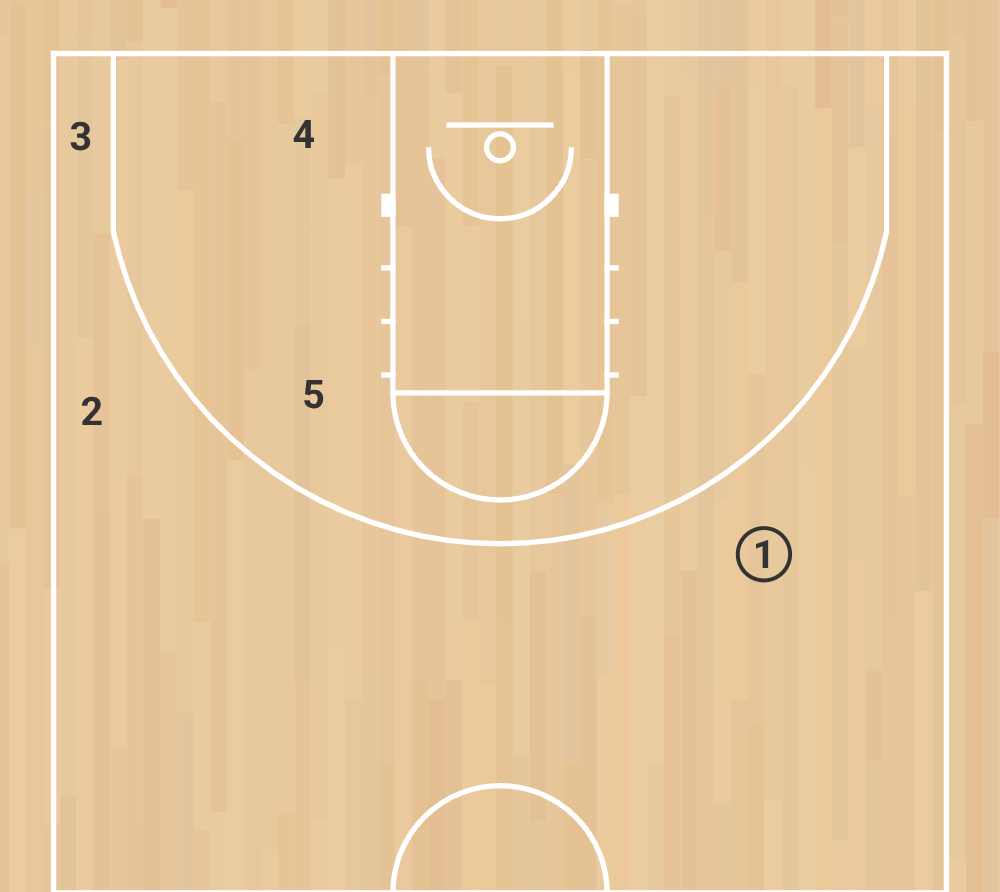
The 1 is on the strongside wing with the ball.
The 2, 3, 4, and 5 are all on the weakside. Depending on the play, they can be arranged with one player in the corner, one on the wing, one near the elbow or slot, and one around the lane line, dunker spot, or short corner.
The exact locations can shift, but the idea remains the same: the defense is forced to guard an overloaded weakside while also respecting the lone ball handler on the opposite wing.
That sounds strange because most offenses overload the strongside. They put the ball and several offensive players on the same side to create immediate passing angles, screening actions, and driving lanes. Quads flips that idea. The ball starts away from the crowd.
That flip is the whole point.
The defense is used to loading toward the ball. Coaches teach shell defense by telling players to be in help position. They teach the low man to be ready. They teach the nail defender to show help. They teach weakside defenders to stunt, tag rollers, bump cutters, and shrink the floor.
Quads stresses those rules because the weakside is no longer just a help side. It is the action side.
The weakside defenders cannot simply relax into help position because their own assignments are involved in screens, cuts, slips, and exchanges. If they stare at the ball, they lose cutters. If they stay attached to their men, the ball handler may have a clean side to attack. If they switch everything, the offense can slip, seal, or throw behind the switch. If they zone it up, the offense can flood the seams.
That is why overloading is powerful. It does not just create one advantage. It creates competing responsibilities.
Why it works against man defense
Against man-to-man defense, Quads creates two major problems.
The first problem is traffic.
When four offensive players occupy one side of the floor, their defenders have to navigate a crowded space. Every cut is harder to track. Every screen matters more. Every switch has to be communicated earlier. If one defender is late, two players can be open. If one defender locks and trails, the cutter can curl. If the defender goes under, the shooter can pop. If the defense switches, the screener can slip.
The second problem is help responsibility.
In a normal spread alignment, the weakside defenders can see the ball and their man. They can help, recover, and rotate in predictable ways. In Quads, those defenders are often occupied by action. They are not just standing in help. They are being screened, backscreened, pinned, lifted, or forced to bump cutters.
That makes help late. And when help is late, the offense gets layups.
The lone strongside player also creates an isolation-like effect without the offense actually being an isolation offense. The ball handler has space. But unlike a true isolation, the other four players are not stationary. They are creating weakside movement that punishes the defense if it overhelps.
This is the core tension:
If the defense commits bodies to the ball, the weakside overload becomes dangerous.
If the defense commits bodies to the weakside action, the ball handler has space.
If the defense switches the weakside action, the offense can screen the screener, slip to the rim, or create a mismatch.
If the defense top-locks shooters, the offense can backcut.
If the defense trails cutters, the offense can curl or reject.
Quads is successful against man because it forces defenders to make decisions in a compressed area, and those decisions have to be made while the ball is sitting alone on the other side of the floor.
Why it works against zone defense
Against zone, the logic changes, but the stress remains.
Zones are built on areas. Each defender owns a part of the floor. The offense tries to put two players in one defender’s area or move the ball fast enough that the zone has to stretch and rotate.
Quads can overload a zone by flooding one side with more bodies than the zone can comfortably handle.
Against a 2-3 zone, for example, a Quads alignment can place players in the weakside corner, wing, short corner, high post, and lane-line areas. That forces the back-line defenders to make choices. The corner defender may have to guard the corner and the short corner. The middle defender may have to protect the rim and account for a flashing big. The top defender may have to bump down or chase a shooter. Suddenly, the zone is no longer clean.
Against a 3-2 zone, Quads can stress the corner and the gaps behind the top line. Against a 1-3-1, it can overload the side of the middle defender and make the baseline runner choose between corner and rim. Against matchup zones, the screening and cutting can turn the defense into a confused man-to-man group without clear matchup rules.
The beauty is that the defense cannot simply say, “We’ll zone this and take away the action.”
If the zone loads toward the four-player side, the lone strongside wing may have room to attack. If the zone shades toward the ball, the overload can create a weakside catch, a short-corner touch, or a hammer pass. If the zone collapses, the skip is there. If the zone extends, the backdoor cut is there.
Against zone, Quads is less about beating one defender off the dribble and more about making the zone guard too many things at once.
Why Quads can become a primary offense
For Quads to become a team’s primary offense, it cannot just be weird. Weird gets you one basket. Maybe two before the defense adjusts. A real offense needs repeatable advantages.
Quads has that potential because the alignment gives you several built-in families of action:
You can play through the strongside wing.
You can hit the high post.
You can run weakside screening actions.
You can flow into handoffs.
You can create empty-side drives.
You can throw back across the floor.
You can use backdoor cuts when defenders deny.
You can screen the screener when the defense switches.
You can turn the overload into hammer action.
You can punish zone by flooding gaps.
That is enough to build an offensive ecosystem.
The biggest thing is that Quads allows a team to start many different possessions from the same picture. That matters. If every play begins differently, the defense gets clues. If the same alignment can produce a slip, a DHO, a cross screen, a blind pig cut, a hammer pass, or an empty-side drive, the defense has to guard the alignment instead of memorizing the play.
That is when a set becomes a system.
A team could live in Quads if it has the right personnel: a strong decision-maker on the wing, a big or forward who can pass from the elbow, at least two credible shooters, and players who understand how to screen and cut. It does not require five elite creators. In fact, part of the appeal is that Quads can manufacture advantages through structure instead of asking every player to win one-on-one.
The offense can also be simplified for players.
The teaching points can become rules:
When your defender overplays, cut backdoor.
When your defender helps, lift or space.
When your screen is switched, slip or seal.
When the ball hits the elbow, cut with purpose.
When the ball handler drives away from the overload, prepare for the throwback.
When the defense loads to the crowd, attack the empty side.
When the defense loads to the ball, punish the crowd side.
That is how you build offense and not just plays.
III. An example play progression
The following four clips fit together well because they are not random actions. They can be taught as a progression.
The progression should start with the simplest stress point: make the defense guard the overloaded weakside while the ball is held on the strongside wing. Then build toward handoff pressure. Then, punish handoff overplay. Then, punish help with the throwback hammer.
The progression could look like this:
First: Establish the weakside overload and the idea that cutters and screeners can create layups before the defense is organized.
Second: Add DHO action to move the ball from the lone strongside player into a second creator.
Third: Counter the defense’s attempt to blow up the DHO by rejecting it and cutting behind the pressure.
Fourth: Punish the defense for overloading the overload with a throwback hammer pass to the far corner.
That is a clean teaching arc.
The defense sees the same basic shape, but the offense keeps changing the punishment.
Play One: Quad Cyclone
The Quad Cyclone is the simplest expression of the idea.
The ball starts with the 1 on the strongside wing. The other four players are loaded on the weakside. The weakside players begin screening and exchanging, with the 5 eventually slipping or cutting into the paint. The 1 has the ability to throw directly to the 5 at the rim or, if the defense collapses, spray the ball back out to the weakside release.
The word “cyclone” fits because the weakside action feels circular. Players are not just cutting in straight lines. They are screening, curling, lifting, slipping, and replacing. The defense sees a cluster, then bodies start moving in different directions.
For a casual fan, the key is simple: four players start on one side, then one of them sneaks behind the defense for a layup while another becomes the safety valve outside.
For a coach, the key is that the action creates layered reads.
The first read is the slip or rim cut. If the 5’s defender is late, hugged up, or worried about the weakside screening traffic, the 1 can throw the direct pass to the rim.
The second read is the weakside lift or flare. If the defense tags the 5, someone has to leave a shooter or release valve. In the clip, the 2 becomes that kind of outlet. The defense cannot take away the rim without giving up something behind it.
The third read is the empty-side attack. If the weakside defenders stay attached and the strongside defender is isolated, the 1 can drive. This is one of the quiet advantages of Quads: the alignment can turn into a driving offense without calling a driving play.
The Cyclone should probably be the first install because it teaches the offense’s core idea. The weakside is not passive. The weakside is the engine.
It also teaches the defense that it cannot fall asleep away from the ball. Once the defense understands that layups can come from the overloaded side, the later actions become more dangerous.
Cyclone Counters
If the defense switches the weakside screens, the screener can slip. The slip is especially dangerous because the defense is switching in traffic, and the ball handler has a wide passing angle from the opposite wing.
If the defense top-locks the weakside shooter, the shooter can backcut. Top-locking means the defender jumps above the offensive player to prevent him from coming off a screen. Against Quads, that can be risky because the paint is already being distorted by other movement.
If the low defender tags the 5’s rim cut, the offense can skip to the corner or lift. That is the classic punishment: help at the rim, give up the shot.
If the defense denies the pass from 1, the 1 can dribble toward the middle and trigger the next layer. This is important if Quads becomes a full offense. The first option cannot be the only option. The ball handler needs a way to keep the possession alive without resetting.
If the defense zones the weakside action, the offense can flash the 5 to the elbow, put the 4 in the short corner, and create a high-low read.
The Cyclone is the “hello” play. It introduces the defense to the problem.
Play Two: Quads DHO Cross Screen Follow
The next layer is the DHO Cross Screen Follow.
A DHO is a dribble handoff. It is basically a handoff where the passer is moving or holding the ball while the receiver runs close enough to take it. Think of it like a pick-and-roll and a pass blended together. It forces the defense to communicate because one player has the ball, another is moving into the ball, and the handoff man can also become a screener.
In this play, the 2 comes out of the weakside overload and works toward the 1 on the strongside. The 1 and 2 connect through the handoff. Now the ball has changed hands, but the defense is still dealing with the original weakside pile-up.
That is where the second action hits.
On the weakside, the 4 sets a cross screen for the 3. A cross screen is a screen that sends a player across the lane or across the body of the defense. The 3 comes across toward the strongside block or lane area. The 2, now with the ball, can feed the 3.
Then the 4 follows.
That follow is the part that makes the action feel complete. The defense may survive the DHO. It may even survive the cross screen. But after setting the cross screen, the 4 does not just stand there. The 4 follows the action into the paint, creating another layup window or dump-off pass.
The progression is excellent because the defense has to guard multiple actions in sequence:
The 2 coming from the weakside toward the handoff.
he 1 and 2 exchange on the strongside.
The 3 coming across the lane off the 4’s screen.
The 4 following into the paint.
That is a lot of defensive communication from the same alignment.
For a casual fan, the play is easy to understand this way: the first movement gets the ball to a new handler, the second movement sends a cutter across the lane, and the third movement sends the screener right behind him.
For coaches, the value is in the timing. The handoff occupies the ball-side defenders. The cross screen occupies the weakside interior defenders. The follow punishes the defense for relaxing after the first catch.
Why this builds naturally from Cyclone
Cyclone tells the defense, “The weakside overload can produce a rim cut.”
The DHO Cross Screen Follow tells the defense, “Even if you guard the first movement, we can turn the same alignment into a second-side action.”
That is how a system grows. You do not want a collection of unrelated plays. You want the defense to feel like each answer creates a new problem.
If the defense starts loading up early to prevent the direct slip from Cyclone, the DHO can move the ball and change the angle. If the defense starts switching weakside screens, the cross-screen follow can create seals and slips. If the defense starts staring at the ball during the DHO, the 3 cuts behind them. If they jump the 3, the 4 follows.
The play is not just designed to get one specific shot. It is designed to create a chain reaction.
DHO cross screen follow counters
If the defense trails the 2 over the handoff, the 2 can keep the ball and drive. The strongside has space, and the original overload can hold help defenders.
If the defense switches the handoff, the 1 can slip or cut after handing it off. This is especially useful if the 1 has size or if the defense switches a smaller guard onto the 1.
If the defense denies the 2 coming to the DHO, the 2 can backcut. That backcut is available because defenders often overplay handoffs once they know the offense wants to get to them.
If the defense switches the 4/3 cross screen, the 3 can seal inside or the 4 can slip into the open space. Switches are only clean if the defenders are on time and balanced. In a Quads cluster, clean switching is harder than it looks.
If the defense top-locks the 3, the 3 can reject the screen and cut to the rim. This is the natural counter to teams that try to sit on the cross screen.
If the defense brings early help to the 3 catch, the 4’s follow becomes the layup. This is the heart of the play. The follow punishes the help.
If the defense zones up, the 3 can catch in the soft spot and become a passer. The 4 diving behind the zone gives the 3 an easy high-low or dump-off read.
Play 3: Quads DHO Reject, Chin Cut, Backscreen, Blind Pig
This is the counterpunch.
Once the defense has seen the DHO, it will start trying to disrupt it. Defenders will jump the handoff. They will deny the receiver. They will sit on the route. They will try to blow up the timing before the offense can get comfortable.
That is where the reject comes in.
The 1 enters the ball to the 5 around the elbow or high-post area. The 2 moves toward the 5 as if he is going to take a handoff. But instead of taking the handoff, the 2 rejects it and cuts behind the defense.
That simple decision changes the defense’s job. The defender who was trying to blow up the handoff is now out of position against a backdoor cut.
This is one of the most important ideas in any good offense: the counter should punish the exact thing the defense is proud of doing.
If the defense is aggressive, use its aggression against it.
After the 2 rejects, the action flows into a chin/backscreen/blind pig concept. The 2’s cut pulls attention toward the rim and the strongside lane. Then the 2 can become a screener for the 1. The 1, who began on the strongside wing and may look like he is out of the play after passing, cuts hard to the basket. The 5, holding the ball at the elbow, hits the 1 on the blind pig pass.
A blind pig is an old Princeton-style concept. In plain English, it is a pass from a big or high-post player to a guard cutting behind the defense. The defender often cannot see both the ball and the cutter, which is why the cut can feel “blind.”
This action is valuable because it uses the 5 as a hub.
The 5 is not just a screener. The 5 becomes the quarterback. He catches at the elbow, watches the defense, and can hit either the first cutter or the second cutter. If the 2 is open on the reject, throw it. If the defense takes that away, the 1 cuts behind the defense for the blind pig.
For a casual fan, the play is this: one player pretends he is coming for the ball, cuts to the rim instead, then helps screen another player who cuts to the rim right after him.
For coaches, the beauty is that the action punishes handoff coverage while keeping the ball in the hands of a passer at the elbow. The defense thinks it has taken away the DHO. In reality, it has walked into the counter.
Why this flows naturally from the DHO
This is the third step in the progression because it only works at maximum force once the defense respects the DHO.
First, Cyclone makes the defense respect weakside movement. Second, DHO Cross Screen Follow makes the defense respect the handoff and second-side screening. Third, DHO Reject punishes the defense for trying to cheat the handoff.
That is real progression. You are not just calling different plays. You are training the defense to react, then punishing the reaction.
A lot of offenses fail because their counters do not connect to their base actions. Quads can avoid that problem. Every counter should feel like a natural answer to the previous defensive adjustment.
DHO Reject/Blind Pig Counters
If the 2’s defender trails or overplays the handoff, the reject cut is available.
If the 2’s defender sits under and protects the cut, the 2 can take the handoff normally and flow into the DHO game.
If the 5’s defender sags too far, the 5 can face up, shoot, drive, or hit the opposite side.
If the 1’s defender loses vision after the entry pass, the blind pig cut is there.
If the defense switches the backscreen for the 1, the 2 can seal the smaller defender or pop out for a shot.
If the defense floods the paint to take away both cuts, the weakside corner and wing should be available. The 3 and 4 cannot be spectators. They should be ready to lift, space, or punish help.
If the defense zones this action, the 5’s elbow catch becomes even more important. The high post is often the best place to distort a zone because the passer can see both the rim and the perimeter.
This play is especially useful against aggressive teams because it invites them to be aggressive. It shows them a handoff, lets them jump it, then cuts behind them.
Play 4: Quads Throwback Hammer
The Throwback Hammer is the big punishment for overhelp.
A hammer action usually means a player drives toward one side of the floor while a shooter is screened into the opposite corner for a skip pass. The pass is often thrown back across the court to the corner. It is one of the most satisfying passes in basketball because the defense is usually looking at the drive when the ball suddenly flies behind it.
In this Quads version, the 1 begins on the strongside wing and dribbles across or toward the overloaded side. As the defense shifts, the weakside group organizes the backside movement. The 2 eventually sprints or loops to the far corner, using the traffic and screening created by the other players. The 1 then throws the ball back across the court to the 2 in the corner.
The logic is simple: make the defense look at the ball and the crowd, then throw the ball away from both.
This is why quads is such an interesting starting point for hammer action. The weakside overload naturally pulls attention. Defenders are already thinking about screens and cutters. When the ball handler drives or dribbles toward that traffic, the defense can easily overreact. The low man steps in. The wing defender bumps down. The corner defender gets sucked toward the lane.
Then the ball goes to the corner.
For a casual fan, this is the “everybody looks one way, ball goes the other way” play.
For coaches, this is a perfect counter to teams that decide to shrink the floor against quads. If they want to overload the overload, the throwback punishes them.
Why this completes the progression
The Throwback Hammer is the fourth step because it punishes the defense for becoming too concerned with the weakside action.
Cyclone creates the first weakside rim threat.
DHO Cross Screen Follow creates a second and third action out of the same spacing.
DHO Reject punishes pressure and denial.
Throwback Hammer punishes help and overreaction.
That gives the offense a clean menu:
If they are late, hit the first action.
If they guard the first action, flow to the second.
If they overplay the handoff, reject it.
If they overhelp the crowd, throw behind them.
That is how Quads becomes more than a clever alignment. It becomes an offensive conversation.
Throwback Hammer Counters
If the defense stays home on the hammer shooter, the 1 should have a driving lane.
If the low man commits to stopping the drive, the hammer pass is there.
If the 2 is top-locked on the way to the corner, he can cut to the rim instead. Top-locking the hammer shooter can create a layup if the screener and passer recognize it.
If the hammer screen is switched, the screener can slip to the rim or seal inside.
If the pass is not available, the ball can be reversed into a catch-and-play situation, with the 2 attacking the closeout or flowing into another DHO.
If the defense zones up and takes away the corner, the middle of the floor should be vulnerable. The high post, short corner, or opposite slot can become the next target.
The hammer is not just a shot. It is a punishment mechanism.
IV. Additional sets within the Quads alignment
The most exciting part of this alignment is that it can hold a lot of different actions. Once the players understand the spacing, quads can become a platform.
Here are some additional sets that fit the structure.
Quads Empty Ballscreen
Start with the 1 alone on the strongside wing. Have the 5 come from the weakside cluster to set an empty-side ball screen for the 1.
The empty side matters because there is no strongside corner defender sitting in easy help. If the defense sends help from the overloaded weakside, the 1 can skip to the shooters or hit the slipping big.
Primary reads:
The 1 turns the corner for a layup.
The 5 rolls into open space.
The weakside low defender tags, opening the corner or lift.
The 5 short rolls and hits cutters coming out of the quads cluster.
This could be a foundational set because it blends modern spread pick-and-roll with the weirdness of the weakside overload.
Quads Ghost Screen
Instead of having the 5 set a physical ball screen, have a shooter or skilled forward sprint out of the weakside group as if he is going to screen for the 1, then slip or pop without making contact.
That is a ghost screen.
It works because the defense has to communicate quickly. Is it a switch? Is it a show? Is it a stay? If the screener is a shooter, the defense may panic and open a driving lane for the 1.
Primary reads:
The ghost screener pops for three.
The 1 drives if both defenders hesitate.
The 5 seals inside if the weakside defense shifts.
The 2 or 3 lifts behind the help.
Quads Spain
Run an empty-side pick-and-roll with the 1 and 5, but have one of the weakside guards backscreen the 5’s defender as the 5 rolls.
That is Spain pick-and-roll logic.
The quads spacing makes it especially interesting because the backscreen comes from the overloaded side. The defense may not see it clearly because there are already bodies stacked on that side.
Primary reads:
The 1 scores if the on-ball defender is screened.
The 5 rolls for a layup or lob.
The back screener pops for three.
The weakside corner becomes available if the low man tags.
Quads Spain Hammer
This is a more aggressive version.
Run the 1/5 ball screen. Have the 2 backscreen the 5’s defender, then continue to the far corner off a hammer screen from the 4.
Now the defense has to cover the ball screen, the roller, the backscreen, the pop, and the hammer corner.
This would be a good late-clock or after-timeout set because it creates multiple high-value options quickly.
Primary reads:
Layup for the 1.
Lob or pocket pass to the 5.
Pop to the 2.
Hammer pass to the corner.
Slip by the 4 if the hammer screen is switched.
Quads Elbow Hub
Enter the ball from the 1 to the 5 at the elbow. After the pass, the 1 cuts through or screens away. The weakside players split around the 5.
This turns quads into a Princeton-style hub offense.
The 5 becomes the passer. The 1 becomes a cutter. The 2 and 3 can split, flare, or backcut. The 4 can duck in or set a backscreen.
Primary reads:
Blind pig pass to the 1.
Backdoor cut by the 2 or 3.
High-low pass to the 4.
Handoff back to the 1.
Flare to a shooter if the defense collapses.
This is one of the best ways to make quads a true offense because it gives the ball a central hub and prevents the alignment from becoming too wing-dominant.
Quads Chicago
A Chicago action is a pindown into a dribble handoff. In quads, the 4 or 5 can set a pindown for the 2, who comes up from the weakside and flows directly into a DHO with the 1.
This is similar in spirit to the DHO action already shown, but it can be organized as a repeatable entry.
Primary reads:
The 2 takes the DHO and drives.
The 2 rejects the DHO and backcuts.
The screener slips after the pindown.
The 1 keeps the ball if the handoff is overplayed.
The weakside corner lifts if the defense tags.
Quads Stack Split
Put the four weakside players in a tighter stack along the lane line or around the elbow/short-corner area. On the trigger, they split in opposite directions: one to the corner, one to the rim, one to the slot, one into a screen.
This is more of a chaos set, but controlled chaos.
The benefit is that the defense cannot easily match up when everyone breaks at once. It can be especially effective after timeouts or underneath/baseline out-of-bounds situations.
Primary reads:
First cutter to the rim.
Shooter popping to the corner.
Screener slipping.
1 attacking the empty side if the defense watches the stack.
Quads Flex
From the weakside overload, run a flex screen: one player screens across the baseline for a teammate cutting to the block, then another player sets a downscreen for the original screener.
Classic flex action can feel old-school, but inside Quads it becomes more deceptive because the defense is already compressed.
Primary reads:
Flex cut for a layup.
Downscreen for a shooter.
Screener slip if the defense switches.
Post seal if a small defender gets caught inside.
Quads Ram into Empty PNR
A ram screen is a screen that frees the player who is about to set the ball screen.
In quads, the 4 can screen for the 5 inside the weakside cluster. The 5 then sprints out to set an empty-side ball screen for the 1.
This is valuable because it makes the 5’s defender late. If the 5’s defender gets screened before the ball screen, the ball-screen coverage becomes messy.
Primary reads:
1 turns the corner.
5 rolls against a late big.
4 pops after setting the ram screen.
Weakside skip if the low man tags.
Quads Veer
A veer action happens when a screener starts to set one screen, then turns and screens a different defender.
In Quads, the 5 can appear to set a ball screen for the 1, then veer away and screen for the 2 lifting from the weakside.
This punishes defenses that load up early to stop the ball screen.
Primary reads:
2 coming off the veer screen for a shot.
1 driving if the defense shifts toward 2.
5 slipping if both defenders chase.
3 lifting from the corner as the next pass.
Quads Flare Series
Use the weakside overload to create flare screens for shooters. The 4 or 5 can screen a defender’s back while the 2 or 3 fades toward the sideline or corner.
This is useful against teams that pack the paint or overhelp on the 1.
Primary reads:
Flare pass to shooter.
Backcut if the defender top-locks.
Slip by the flare screener.
1 attacks if the defense stays attached.
Quads UCLA
The 1 passes to the 5 at the elbow, then cuts off a backscreen from the 4 toward the rim. This is a simple UCLA cut, but the quads spacing gives it extra deception.
Primary reads:
1 on the UCLA cut.
4 slipping after the screen.
5 handoff to 2 if the cut is covered.
3 lifting from corner for a shot.
This can pair nicely with the blind pig concepts because both punish defenders who lose sight of the cutter after the entry pass.
Quads Weakside Stagger
Have two of the overloaded players set a staggered screen for a shooter coming from the corner to the top or slot.
This gives the offense a traditional off-ball shooting action from a nontraditional alignment.
Primary reads:
Shooter off the stagger.
Curl if trailed.
Slip by the second screener.
Backdoor if top-locked.
1 drive if the defense overplays the stagger.
Quads Duck-In
Use the overload to create a deep post seal. The 4 or 5 screens across, then ducks into the paint as the 1 holds the ball on the wing.
This is good if the team has a physical forward or big who can score inside.
Primary reads:
Deep seal.
Opposite shooter if the defense digs.
High-low from the 5.
Re-screen if the post is fronted.
Quads Delay Flow
After any initial quads action fails, flow into a delay-style offense with the 5 at the top or elbow and the other players spacing around him.
This is important for making quads a primary offense. Not every possession will produce a layup on the first cut. The team needs a natural second phase.
Primary reads:
5 handoff to 1 or 2.
Backdoor cuts from the wings.
Weakside split action.
Keeper by the 5.
Slot-to-slot reversal into another Quads setup.
V. Potential downsides of overloading the weakside
As much as I like the alignment, the weaknesses matter.
Overloading the weakside can be powerful because it breaks normal defensive geography. But that same unusual geography can create problems for the offense if the timing, spacing, and personnel are not right.
The floor can get crowded
Four players on one side sounds like a spacing advantage because it manipulates the defense. But if those four players are too close together, it can become a spacing problem.
There is a fine line between an overload and a pile-up.
The offense needs clear landmarks. The corner cannot drift too high. The wing cannot stand in the cutter’s path. The big cannot clog the lane unless he is screening, sealing, or flashing. The weakside players must understand that they are close together for a reason. They are not just hanging out in the same neighborhood.
For casual fans, this is the difference between organized traffic and a traffic jam.
Passing angles can be difficult
Quads can create beautiful passes, but some of them are difficult. The strongside wing may have to throw a long diagonal pass to the rim, a skip to the corner, or a pass through a crowded middle.
Against long, athletic defenses, those windows can close quickly.
This is especially important against teams that pressure the ball. If the 1 is uncomfortable, the whole alignment can stall. If the 5 is not a good passer, the elbow hub actions lose value. If the shooters are not respected, defenders can sit in passing lanes.
The offense needs passers, not just play-call execution.
The lone strongside player can be trapped
Because the 1 is alone on the strongside wing, the defense may decide to attack him.
A smart opponent could pressure the ball, force the 1 toward the sideline, and make the first pass difficult. If the weakside players are too far away or too static, the 1 can get stuck.
The answer is to build in releases.
One weakside player has to know when to flash to the middle. The 5 has to be available at the elbow. The 2 has to be able to sprint into a DHO or safety valve. The 1 has to be able to dribble out of pressure without killing the spacing.
Quads cannot be a sculpture. It has to breathe.
Switching can flatten the action
If a defense is comfortable switching off-ball screens, some of the weakside movement can lose its initial punch.
That does not mean Quads is dead. It just means the offense must punish switches properly.
Against switches, screeners have to slip. Cutters have to seal. Shooters have to flare. Bigs have to duck in. Guards have to recognize mismatches. If everyone simply runs the drawn route, a switching defense can stay attached.
This is one reason Quads should be taught through reads, not just choreography.
Zones can turn overload into a crowd
Against zone, overloading can create problems for the defense. But if the offense is too static, it can also help the zone.
Zones like guarding areas. If four offensive players stand in the same area without movement, the zone can guard space instead of people. The overload only works if it forces the zone to make choices.
That means Quads against zone needs flashes, short-corner touches, corner lifts, high-low reads, and quick reversals. The offense has to make the zone stretch. If the ball sticks, the zone wins.
Transition defense can suffer
Any time four players are on one side of the floor, the offense has to think about balance.
A turnover out of quads can be dangerous because the floor may be tilted. If the ball is skipped across the court and stolen, the defense can run. If the weakside cluster is below the ball and the 1 is the only player above the action, the team may be vulnerable in transition.
This does not mean the offense should avoid quads. It means the staff has to assign floor-balance rules.
Who is the safety?
Who crashes?
Who gets back?
Who protects against the long rebound from the hammer corner?
An unusual offensive alignment requires unusual transition rules.
It requires real timing
Some offenses are forgiving. Quads is not always forgiving.
Because the advantage comes from spacing manipulation and layered cuts, the timing has to be precise. The 2 cannot arrive at the handoff before the 1 is ready. The 4 cannot cross screen before the 3 has set up his defender. The 5 cannot flash to the elbow and then hold the ball forever. The hammer shooter cannot leave early or late.
The timing is teachable, but it has to be taught.
This is one of the major differences between using Quads as a package and using it as a primary offense. A package can survive on surprise. A primary offense has to survive after the defense knows what is coming.
It can become too cute
This is probably the biggest philosophical danger. Quads is fun. It looks different. It invites creativity. That is good.
But the goal is still to create good shots.
If the offense becomes too obsessed with the cleverness of the alignment, it can lose sight of the point. The best Quads possessions should still feel simple at the end: layup, corner three, mismatch, drive, high-low, open catch-and-shoot.
The complexity should be for the defense, not for the offense.
The players should feel like they are making simple reads from an unusual formation. If the players feel like they are memorizing a 12-step dance, the offense will eventually slow down.
VI. Conclusion: From garage project to offensive identity
That is why I keep coming back to Quads.
At first glance, it looks like a trick. Four players on the weakside, one player alone on the strongside wing. It does not look like the balanced spacing we are used to seeing. It looks like somebody moved the furniture to one side of the room.
But the more you sit with it, the more it makes sense.
The alignment bends the defense before the play starts. It turns the weakside into the action side. It gives the ball handler space while forcing the other four defenders to guard traffic. It creates natural answers against man and zone. It can flow into slips, handoffs, cross screens, blind pig cuts, hammer passes, and empty-side attacks.
The plays fit together because they are not separate ideas. They are chapters in the same book.
Quad Cyclone introduces the overload and creates the first rim/skip dilemma.
DHO Cross Screen Follow adds a handoff and layers a second action behind it.
DHO Reject, Chin Cut, Backscreen, Blind Pig punishes the defense for overplaying the handoff.
Throwback Hammer punishes the defense for overhelping and staring at the crowd.
That is the progression. That is the offensive conversation.
And the best part is that there is still so much room to build. Quads can become Chicago action. It can become Spain pick-and-roll. It can become elbow hub. It can become hammer, flex, flare, UCLA, empty ball screen, ghost screen, or delay flow. The alignment is not the whole offense. It is the doorway into the offense.
The downsides are real. The spacing can get crowded. The passing windows can be tough. The timing has to be sharp. The strongside trigger can be pressured. Switching defenses can flatten lazy movement. Zones can swallow a static overload. Transition defense has to be accounted for.
But those are coaching problems, not dealbreakers.
That is what makes the concept exciting. It is not finished in the sense that all good offenses are never truly finished. It is a framework that can keep growing as defenses respond.
So, to bring it back to the beginning: this is me opening the garage. Not just pointing at someone else’s car and explaining why it runs, but showing the thing I have been tinkering with myself.
Quads may start as an odd alignment. It may start as a quick hit. It may start as a way to steal a basket after a timeout.
But with enough counters, teaching, and commitment, it can become something bigger.
It can become an offense.